AI-Generated Content: Revolutionizing, Yet Raising Red Flags
The Role of AI in Redefining Content
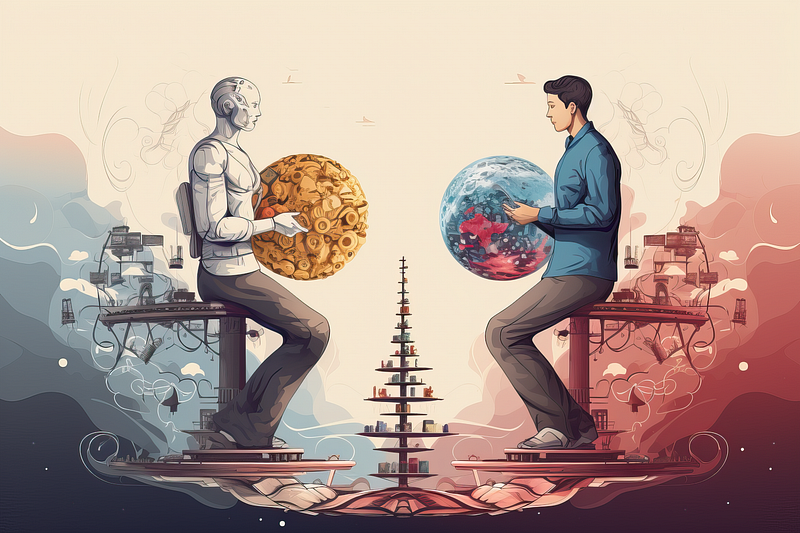
Balancing AI Efficiency and Human Creativity
In today’s rapidly evolving digital landscape, AI-generated content has emerged as a double-edged sword. Amanda Hetler, Senior Editor for WhatIs defines AI-generated content as machine-produced copy encompassing various forms, from articles and blogs to marketing materials. While AI content generators offer efficiency, cost-effectiveness, and SEO improvements, they also introduce significant concerns. One pressing issue, as highlighted by Stuart A. Thompson of The New York Times and Matthew Cantor of Guardian US, is the proliferation of AI-generated content in fringe news sites, content farms, and product reviews, often disseminating fabricated information and medical advice. Recognizing AI-generated content can be challenging, but repetitive phrases, bland language, and occasional error messages like “I cannot complete this prompt” can serve as indicators. As AI and content creation continue to evolve, preserving transparency and integrity in online content becomes paramount. Both content consumers and creators must strike a delicate balance between AI-powered efficiency and human creativity in this dynamic landscape.
Understanding AI-Generated Content
AI-generated content, as defined by Amanda Hetler in her article, refers to copy, such as blogs, marketing materials, articles, and product descriptions, created entirely or mostly by machines. These AI content generators produce text based on input from users, including keywords, phrases, and topics. This technology has been gaining traction in recent years and is poised to redefine how we approach content creation.
The Pros of AI-Generated Content
- Efficiency and Scalability: AI can generate content at a remarkable speed, far surpassing the capabilities of human writers. Hetler points out that an AI tool can produce an article within minutes, a task that would take a human significantly longer. This efficiency allows businesses to churn out a substantial amount of content quickly.
- Cost-Effective: While hiring quality human content writers can be expensive, some AI writing tools offer cost-effective solutions. As Hetler notes, pricing for AI-generated content tools typically runs around $0-$100 for tens of thousands of words, making it a budget-friendly alternative for businesses.
- Improves SEO: AI content generators excel at optimizing content for search engines. By analyzing vast amounts of online data, these tools identify keywords to enhance search engine rankings. AI can even suggest keywords to human writers, thus improving the discoverability of content.
- Overcoming Writer’s Block: Writer’s block can be a significant hurdle for content creators. AI tools, as mentioned by Hetler, can provide detailed outlines and key points, helping writers overcome creative blocks and kickstart their writing process.
The Cons of AI-Generated Content
- Model Collapse: Deteriorating content quality due to increasingly polluted datasets, a phenomenon referred to as “model collapse” by Ross Anderson of University of Cambridge. AI models are ingesting low-quality content, compounding deficiencies with each iteration of training. This raises concerns about the future of AI-generated content, potentially inundating the information landscape with mediocre and misleading material, eroding trust, and blurring the lines between human and AI-generated articles.
- Quality Concerns and Possible Plagiarism: AI-generated content relies on data and algorithms, which can sometimes result in a lack of authenticity and originality. As Hetler points out, AI tools may struggle with gray areas and tend to produce content that resembles existing materials, potentially leading to plagiarism concerns.
- Algorithms Devalue Content: Google’s algorithm updates prioritize content created by humans, as highlighted by Hetler in her article about AI-generated content. According to Hetler, Google’s content update in August 2022 emphasizes the importance of ‘helpful content written by people, for people.’ This update indicates that search engines favor content authored by humans, as it contributes to a more cohesive and satisfying SEO experience.
- Lack of Creativity and Personalization: Creative and personalized content often resonates more with readers. Unfortunately, AI lacks the emotional intelligence to craft engaging stories or understand user intent, often resulting in factual but dry content.
- Human Editing Still Required: Although AI can automate content creation, human involvement remains essential. Writers and editors must review AI-generated content for accuracy, coherence, and context, adding an extra layer of effort.
- Inability to Generate New Ideas: AI relies on existing data, making it challenging to produce fresh, innovative content. It excels at replicating existing information but struggles with creativity.
AI-Generated Content in the News
Recent reports, such as those by Stuart A. Thompson and Matthew Cantor, have shed light on the widespread use of AI-generated content across various websites, including news sources, content farms, and product review platforms.
Stuart A. Thompson’s report reveals that fringe news websites, content farms, and fake reviewers have adopted AI to produce inauthentic content. This includes fabricated events, medical advice, and even celebrity death hoaxes. This trend raises concerns about the potential for AI to exacerbate misinformation problems online.
Matthew Cantor’s investigation, meanwhile, uncovered nearly 50 news websites allegedly generating content almost entirely through AI. Many of these sites lack clear authorship and publish articles with AI error messages, making them appear dubious. However, the presence of false information on these sites poses a significant challenge, as AI-generated content can potentially perpetuate the cycle of misinformation.
Identifying AI-Generated Content
Detecting AI-generated content can be challenging, as it often mimics human writing styles. However, there are some telltale signs, for instance, AI-generated text tends to exhibit a lack of typos and the overuse of common words like “the,” “it,” or “is.” Moreover, AI-generated content typically omits cited sources, features shorter sentences that might appear choppy, and exhibits repetition of certain words or phrases, often used to fill space with relevant keywords. Furthermore, AI-generated content often lacks in-depth analysis, focusing more on presenting facts without offering insightful interpretations.
Conclusion
AI-generated content is undeniably transforming the content creation landscape, offering efficiency, cost-effectiveness, and improved SEO. However, it also raises concerns about authenticity, creativity, and the potential to perpetuate misinformation. As technology evolves, it’s crucial for both consumers and creators of content to remain vigilant and discerning.
As the line between human and AI-generated content blurs, it becomes increasingly important to uphold the principles of transparency and integrity in online content. As consumers, we must stay informed and critical, while creators should strive to find the right balance between human creativity and AI-powered efficiency. In this evolving landscape, the future of content creation remains both exciting and challenging.